
You’ve probably heard it: most kids aren’t strong writers. We dug into the numbers to see if it holds up, and what parents can actually do about it.
Are most kids really behind in writing?
Mostly true, with an asterisk. The number comes from the Nation’s Report Card (NAEP), the only test that measures writing the same way across the whole country. In its last reported writing test, about 27% of 8th and 12th graders scored proficient or above. That means roughly 3 in 4 didn’t.
The asterisk: that test was given in 2011. Here’s what’s happened since:
- The 2017 writing test was never released. Kids took it on tablets instead of laptops, and 8th graders on tablets scored lower than students on laptops. The government couldn’t tell how much of the drop was writing and how much was the device, so it didn’t publish the results.
- There’s no national writing test on the calendar. The current NAEP schedule runs through 2033 and doesn’t include writing for any grade.
- State tests tell the same story. Every state now uses its own reading and writing test, and in most of them about half of students or fewer hit the proficient mark. More on that below.
So “3 in 4 kids aren’t proficient writers” is fair, but the real story is in the footnotes. The last two national writing tests were both typed, and the one that wasn’t released ran into trouble partly because of the device kids typed on. Writing and typing are now tangled together.
How the states compare
| State | 8th graders proficient or above in reading, 2024 |
|---|---|
| Massachusetts (highest) | 40% |
| New Jersey | 38% |
| Maryland | 33% |
| Ohio | 32% |
| Pennsylvania | 31% |
| New York | 31% |
| National average (public schools) | 29% |
| Virginia | 29% |
| Delaware | 23% |
| West Virginia | 21% |
| New Mexico (lowest) | 19% |
There’s no recent state-by-state writing test, so the best current comparison is reading, the skill writing is built on. On the 2024 Nation’s Report Card, fewer than a third of 8th graders in most states read at a proficient level. Even the top state doesn’t reach half.
Source: NAEP 2024 grade 8 reading results by state; state figures can be checked in each NCES state snapshot.
Today every state uses its own test, so the numbers don’t line up neatly, but the pattern holds:
- Massachusetts: 44% of 8th graders and 51% of 10th graders met expectations in English language arts in 2025, in one of the country’s top-scoring states.
- Texas: after the state test moved online with a new essay question in 2023, almost half of 4th graders scored a zero on the writing task. The state cautions against comparing that year with earlier ones.
- Pennsylvania: 49.9% proficient in English language arts in 2025, down from 53.9% the year before. On the 7th grade sample essay question, the average score was 1.88 out of 4.
Bottom line: “3 in 4 aren’t proficient” holds up with today’s numbers. Nationally, about 7 in 10 eighth graders aren’t proficient readers, and even Massachusetts, the top state, is at 40%. No state is where it needs to be, which is why help at home matters.
The why: writing and typing are now the same test
Our kids learn to write with a pencil, but they get tested on a keyboard. Most state tests are now taken on a computer, so written answers are typed, and talk-to-text generally isn’t allowed.
That matters more than it sounds:
- Typing speed shows up in the scores. On the 2011 national writing test, students with more key presses scored higher on average.
- Practice at school helps. Students whose teachers had them write and edit on computers more often did better.
- When typing is automatic, kids write better. A 2023 study of 544 second graders found that fast, automatic typing predicted both the quality and the fluency of their writing.
- Schools are noticing. Some districts have found their middle schoolers hunting for keys one at a time on state tests. “Our students don’t really know how to type,” one middle school principal said.
Think about it this way: if your kid is hunting for the letter G, they’re not thinking about their argument. Typing isn’t the whole fix for writing, but it clears the road so the thinking can happen.
The how: a typing path from kindergarten to 8th grade
Our free typing game, Keyboard Quest, grows with your kid: five islands, each one a step up, so the keyboard is old news by the time the big tests show up. It’s built for a real keyboard, the typing boxes have spellcheck turned off, and accuracy always comes first. Speed badges unlock only at 90% accuracy or better.
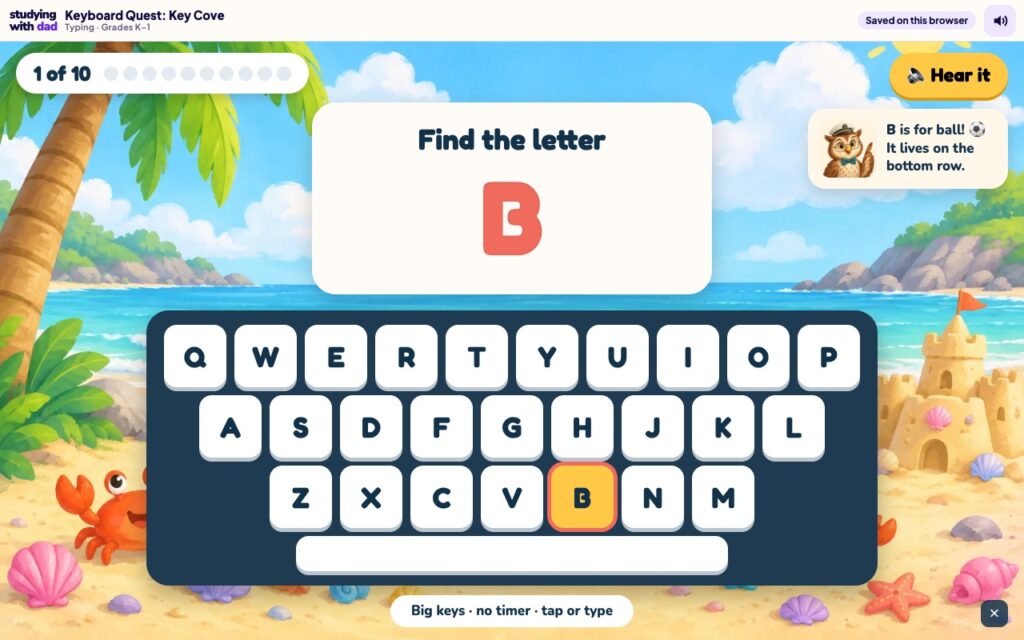
- Key Cove (kindergarten and 1st grade). Professor Keys, an owl in a captain’s hat, calls out a letter, and your kid finds it on big, friendly keys. There’s no timer. Along the way they meet the space bar, Backspace and Shift, and type their own first name.
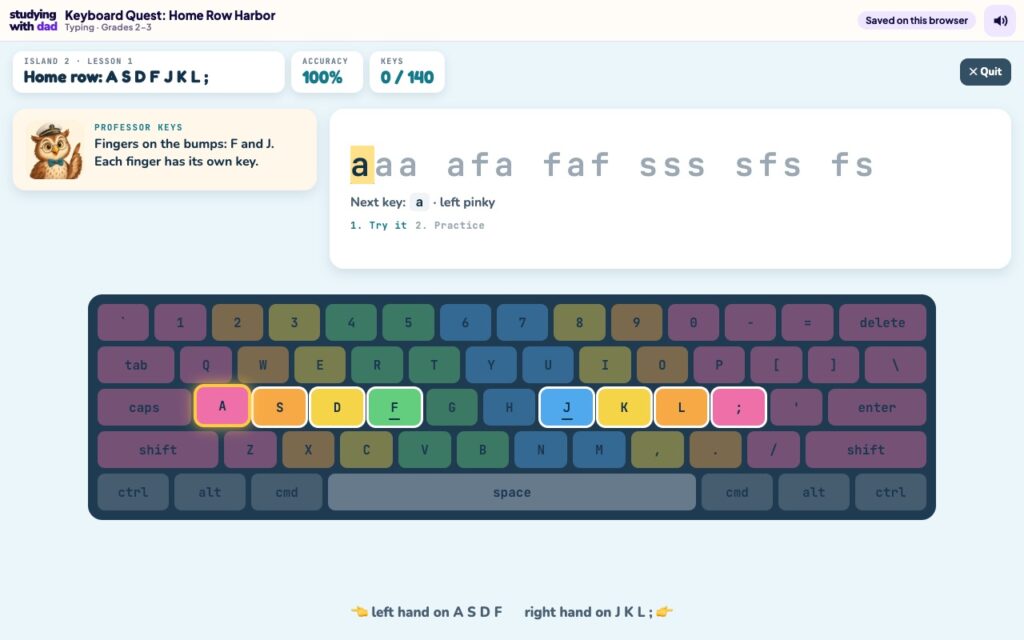
- Home Row Harbor (2nd and 3rd grade). Touch typing starts here. Fingers go on the bumps on F and J, every key is colored by the finger that presses it, and the game names the finger for the next key. Then it works up and down the keyboard, and a later lesson fades the keyboard away so eyes stay on the screen.
- Speed Springs (4th and 5th grade). Capitals, commas, question marks, quotation marks and the number row, plus sentences from real books and races where every right key moves a swimmer or a sailboat forward.
- Power Peak (6th and 7th grade). Symbols, bold and links, moving around a document without the mouse, and a Ghost Race against your own best time.
- Pro Port (8th grade). Real-world typing: emails, forms, and a final exam of 40 words per minute at 95% accuracy.
From typing to writing: the games that build the essay
Once the fingers know where to go, these levels put typing to work on the kind of writing the tests ask for.
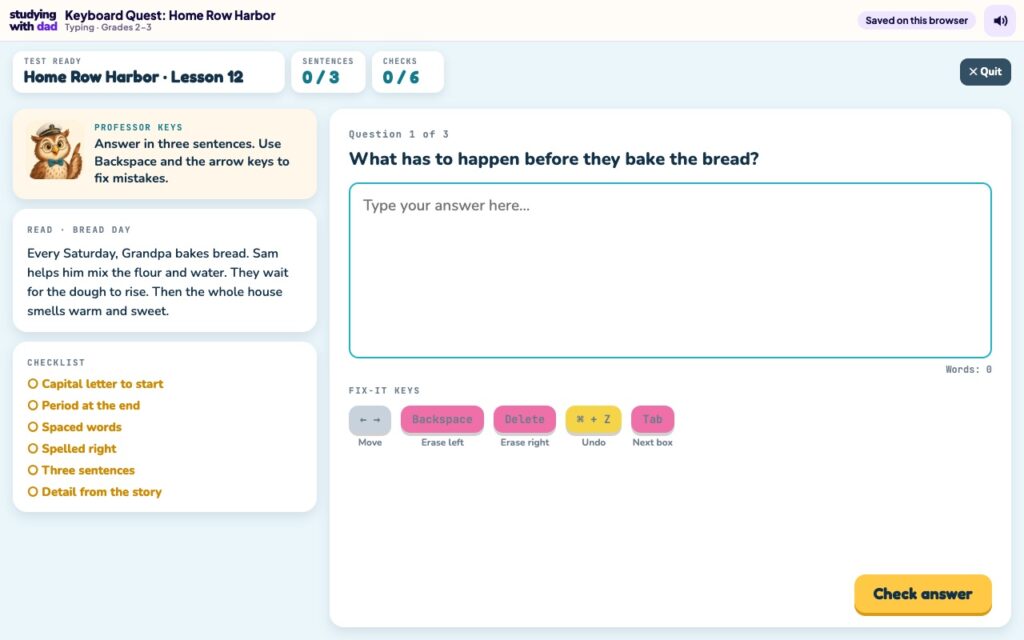
- Test Ready (2nd and 3rd grade). In Home Row Harbor, kids read a short story and type a three-sentence answer to a question about it. A checklist ticks off as they go: a capital to start, a period at the end, words spelled right, and a detail from the story. Backspace, Delete, the arrow keys and Undo are right there for fixing mistakes, just as they would be on a test.
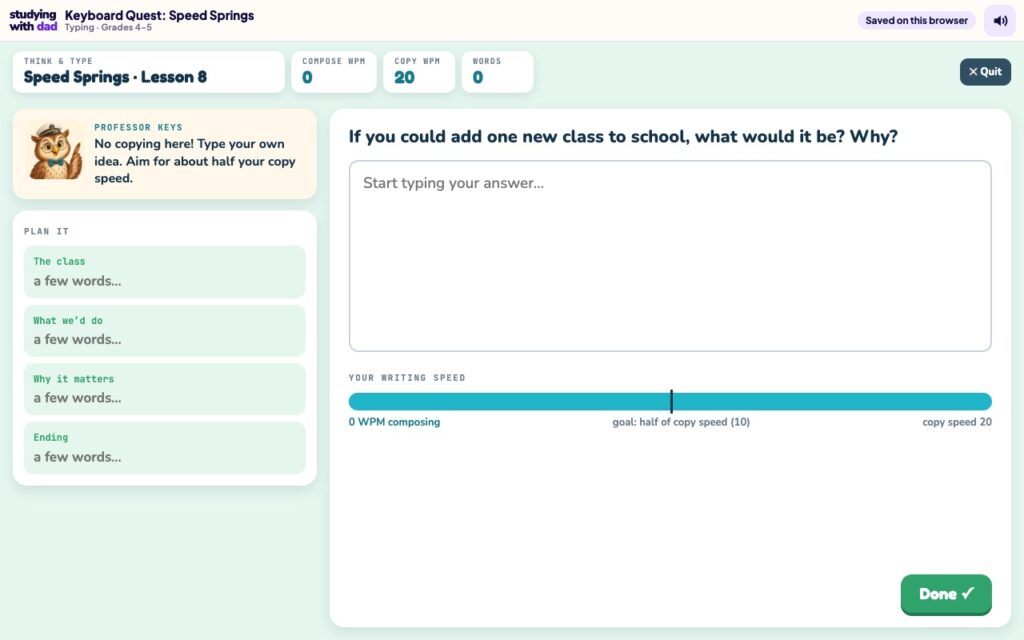
- Think & Type (4th and 5th grade). In Speed Springs there’s nothing to copy. Kids jot a quick four-part plan, then type their own answer, and a speed bar compares how fast they compose with how fast they copy. The first goal is half their copy speed.
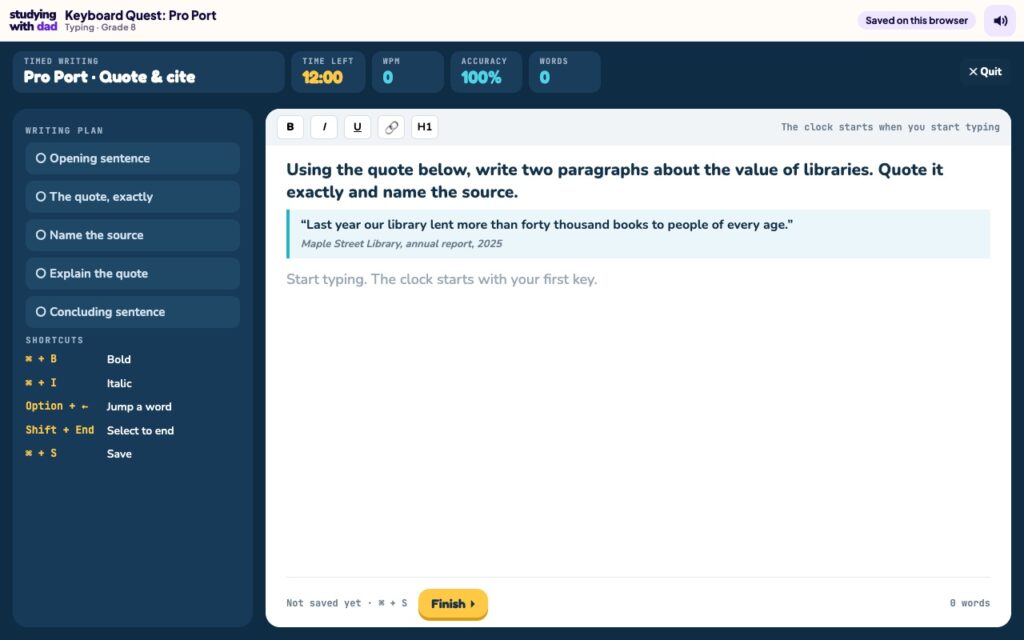
- Timed writing (6th to 8th grade). Power Peak and Pro Port give a prompt, a plan to tick off (introduction, body paragraphs, conclusion, proofread) and a clock that starts with the first key. In Pro Port’s Quote & cite, kids use a quote exactly as written and name its source, the same move a state test essay asks for.
Our writing games build the paragraphs those answers are made of:
- Idea Burger (3rd grade). A paragraph is a burger: the opinion on top, the reasons in the middle, the closing on the bottom.
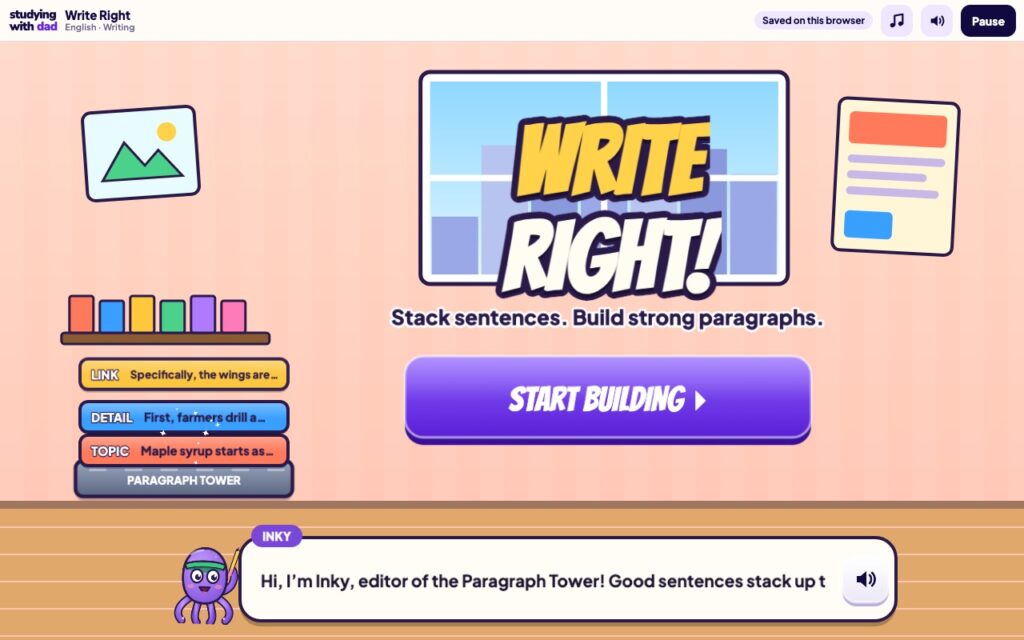
- Write Right (5th grade). Every good sentence choice stacks a block on the Paragraph Tower, from the topic sentence to the details, across informative, opinion and story paragraphs, plus a revising round.
- Explode the Moment (5th grade). Turn flat sentences into scenes kids can see, hear and feel, and punctuate dialogue.
- The Press Box (6th grade). Make the call about a story, then find the exact sentence that proves it. That’s the “how do you know?” behind every evidence essay.
Easy things you can do this week
You don’t need to be a teacher for any of this. Ten minutes at the kitchen table counts.
- Ten minutes, a few times a week. Short and often beats one long Saturday session.
- Accuracy first, speed later. Speed shows up on its own once fingers know where to go.
- Get a real keyboard. If your kid mostly uses a tablet, a cheap plug-in or Bluetooth keyboard makes practice match the test.
- Hands home, eyes up. Fingers on the bumps on F and J, thumbs on the space bar, eyes on the screen instead of the keys.
- Type, don’t talk. Save talk-to-text for grown-up errands and let your kid type their own homework when they can.
- Write it, then type it. A rough draft on paper, then typed up, is exactly the routine many schools now use.
- Ask “how do you know?” At dinner, after a movie, about a news story. It’s the same question the state essay asks, out loud.
Sources
- The Nation’s Report Card: Writing 2011 and Education Week coverage
- NCES: the 2017 NAEP writing assessment
- American Academy of Arts & Sciences: Writing Proficiency
- NAEP 2024 grade 8 reading results by state and the NCES 2024 state reading snapshots
- Pennsylvania 2024–25 assessment results and the 2025 PSSA grade 7 ELA sampler
- EdTrust: The State of Adolescent Literacy in Massachusetts
- KERA News: Texas STAAR writing zeros
- News report: middle schoolers struggling to type on state tests (2026)
- Malpique et al., “The keys of keyboard-based writing”, 2023