Pierre, Montpelier, Harrisburg: How to Make State Capitals Stick
By Instructor Dad ·
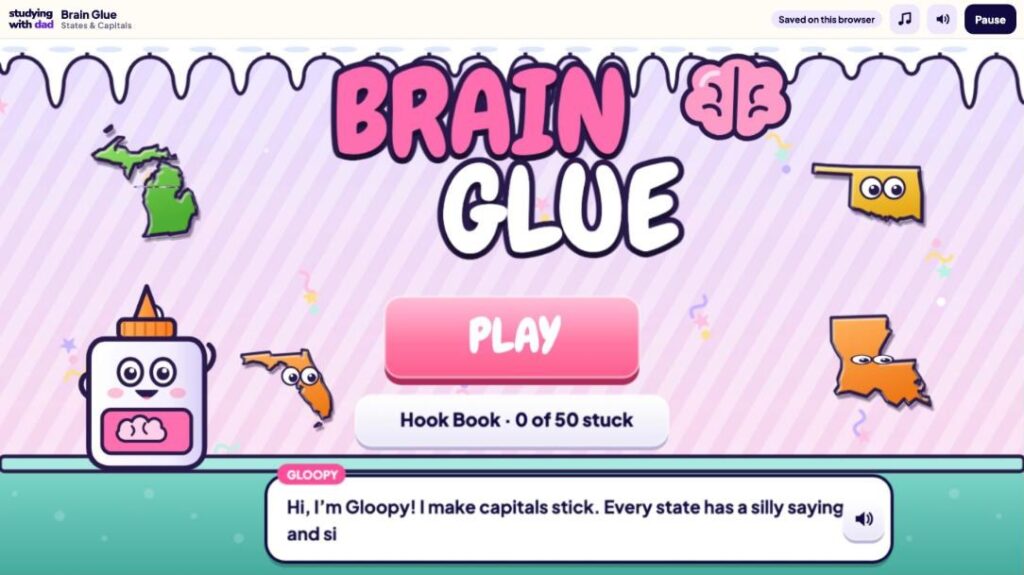
It’s Sunday night. The state capitals quiz is on Friday, and the list of 50 has turned into a blur: Pierre, Montpelier, Harrisburg, Bismarck, Augusta. Reading the list again won’t help much. What helps is giving each capital something to stick to, a silly picture that links it to its state, and then practicing until it comes back on its own.
Memory hooks beat rereading
Facts like capitals stick when kids practice pulling them out of memory: in a well-known study, students who were quizzed remembered far more a week later than students who reread the same material (Roediger and Karpicke, 2006).
Memory hooks make that retrieval easier. A funny picture, like a pier sticking out of South Dakota for Pierre, gives the brain a path back to the answer. The sillier the picture, the better it sticks.
How Brain Glue helps
Brain Glue is a memory game with Gloopy the glue bottle. Each session teaches 3 new capitals with a memory hook: a funny picture that links the capital to its state. Then mixed rounds practice them every way: state shape to capital, state name to capital, and capital to state shape.
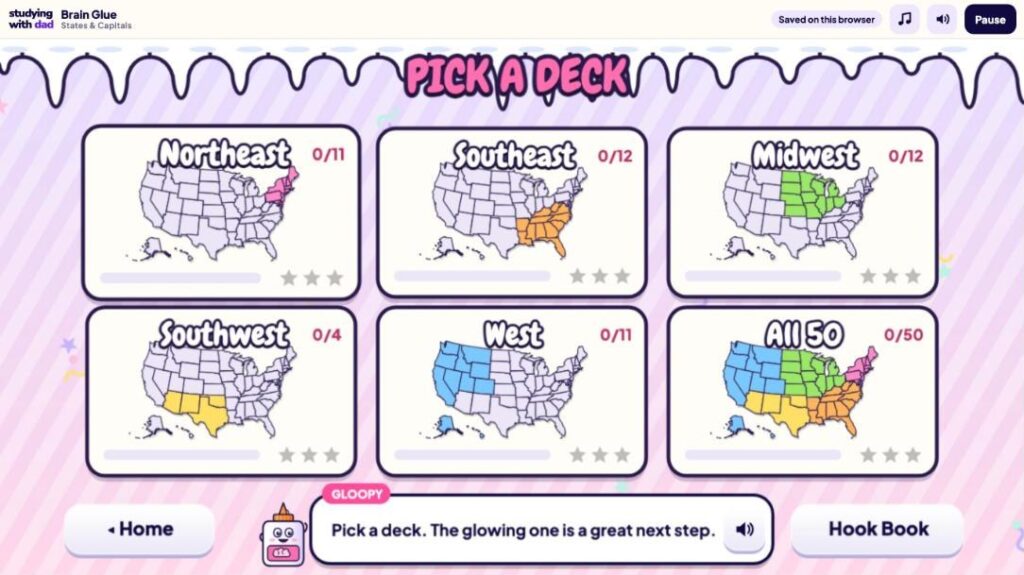
Kids can study by region (Northeast, Southeast, Midwest, Southwest and West) or take on all 50. A miss shows the hook again, and the Hook Book keeps track of how many capitals are stuck. Helpful to know first: what a state and a capital are.
For homeschool families
Brain Glue teaches three capitals at a time, so it fits a short daily slot.
- Ten minutes a day. A session with 3 new capitals takes about 10 minutes, and it teaches each one with a picture hook before the practice rounds.
- Draw your own hooks. Have your child draw a picture for any capital that won’t stick, since making the picture is half the memory work.
Where Brain Glue fits in your curriculum
If you follow a set program, here’s roughly where Brain Glue lines up:
- Any homeschool geography or U.S. studies program: Brain Glue covers all 50 states and capitals, so it fits any U.S. geography unit or states-and-capitals project.
- State standards: many states expect students to locate the states and know their capitals in 4th or 5th grade.
More games to try
If your child likes Brain Glue, these free games build the same skills from different angles:
- Capital Cards: a card game for matching states and capitals.
- Wobble Tower: states, shapes and capitals with a physics tower.
- Map Snap: a quick states and capitals drill.
Questions parents ask
What’s the fastest way to learn the 50 state capitals? Learn a few at a time with memory hooks, quiz yourself instead of rereading, and review old ones while you add new ones.
Which state capitals are hardest? Usually the ones that aren’t the biggest city in the state, like Pierre, Montpelier, Harrisburg, Albany and Springfield.
How many capitals should kids learn at once? Three to five new ones per session, mixed with review of the ones they already know, works well for most kids.
Is Brain Glue free? Yes. There’s no cost and no ads, here or in any other game on the site. Kids sign in with a free family account, and their progress saves there.
Sources
- Henry L. Roediger III and Jeffrey D. Karpicke, “Test-Enhanced Learning: Taking Memory Tests Improves Long-Term Retention”, Psychological Science, 2006.
- Brain Glue game page, Studying with Dad.