Memory Techniques for Kids: Recall, Connections, and Useful Cues
By Instructor Dad ·
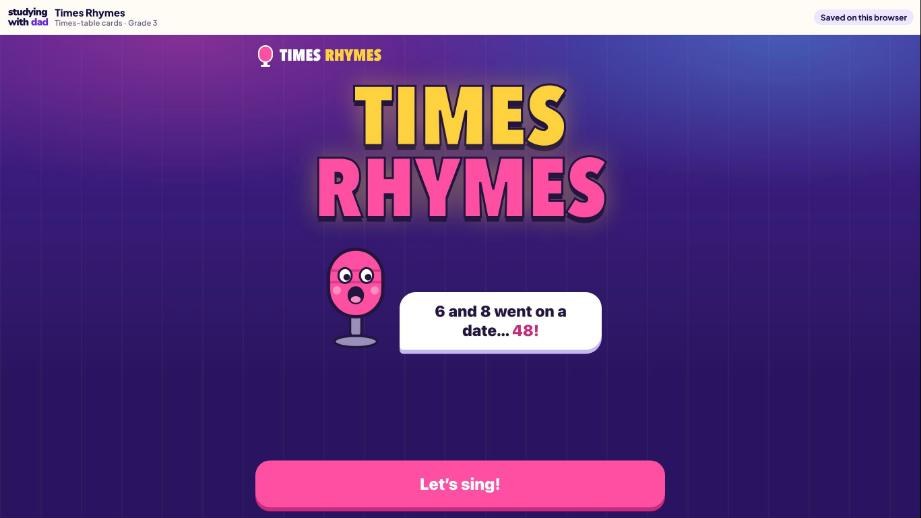
Useful memory techniques help a child retrieve information, connect it to something meaningful, and check that it is right. A rhyme or picture can be a cue, but it should lead back to the actual fact rather than become another confusing thing to memorize.
Start with a small set. Learning five well-chosen pairs gives you something to check without turning practice into an endurance event. A short, focused session is usually enough.
Separate understanding from remembering
Some tasks require a fact, such as a capital. Others require understanding a relationship, such as why equivalent fractions have the same value. A catchy phrase cannot replace the explanation.
Before making a mnemonic, ask the child to explain the idea in ordinary language. If the idea is unfamiliar, teach it first. If it is understood but difficult to retrieve, a memory cue may be useful.
Three approaches to combine
Retrieve: Look away from the answer and try to say or write it. Check afterward and correct errors.
Connect: Tie the fact to a category, map location, example, or earlier idea. “Augusta belongs with Maine in the Northeast” gives the pair some context.
Cue: Create a short, distinctive image or phrase. For Maine and Augusta, a child might picture “a gust” blowing across a Maine map. Explain that the picture is a made-up reminder, not the history of the name.
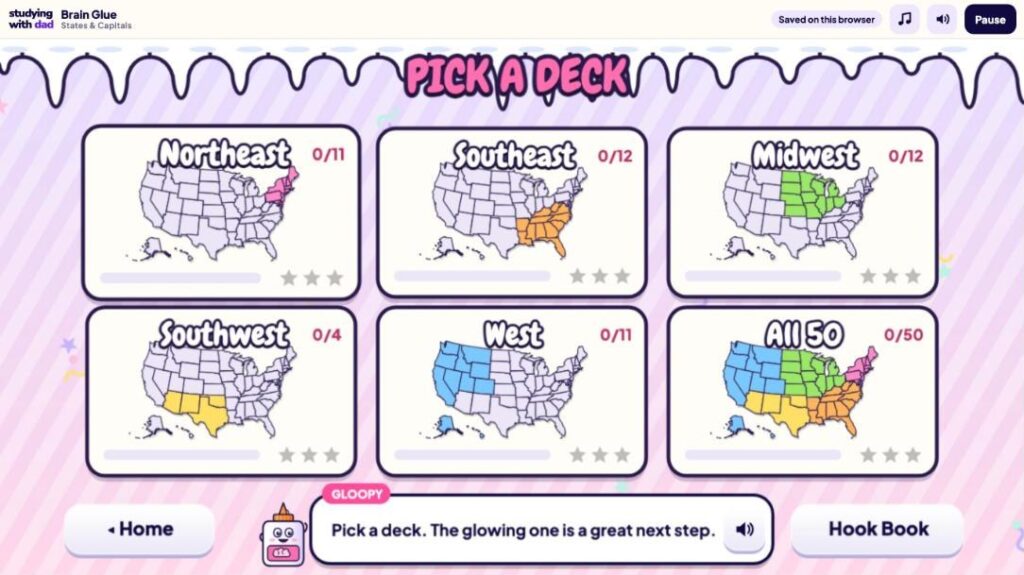
Brain Glue, a 5th-grade capitals game, is built on this kind of cue. Gloopy the glue bottle introduces three capitals at a time, each with a silly picture hook, such as a pier sticking out of South Dakota for Pierre. A miss shows the hook again, and kids can practice one region at a time, which adds the connection step.
The IES study guide includes spaced learning and quizzing among its recommendations. It does not certify any particular rhyme, app, or memory character.

Worked example: checking both directions
Write Maine on one side of a card and Augusta on the other. Ask for the capital, check it, and later reverse the task: “Which state has Augusta as its capital?”
If one direction works and the other does not, note that difference. Mix the card among other states rather than always leaving it in the same position. Otherwise, the child may remember the order of the cards instead of the pair.
Capital Cards keeps the deck moving the same way. Kids match state cards to capital cards, and missed states come back later in the round rather than right away. Its tricky rounds also mix real capitals with famous cities that are not capitals, which tests the pair instead of the first city that comes to mind.
Try this five-minute activity
Pick three current facts. Let your child make one meaningful connection for each. Cover the answers and ask for recall. Check together, then select one fact to revisit on another day.
Do not turn the second attempt into a trick. Say exactly what you are testing: “Let's see which pair we can remember without looking.”
Dinner-table question: “Which picture or connection helped, and which one made the fact more confusing?”
Common questions
Should every fact get a silly story?
No. Too many stories can become their own workload. Use a cue for a stubborn mix-up, then check whether it helps retrieve the correct fact.
What if they remember it today but not tomorrow?
Treat that as information for the next practice session. Revisit the correct pair, try again later, and avoid declaring the previous session a failure.
Try a memory-focused activity
Brain Glue and Capital Cards both practice state-capital pairs, and Map Snap adds quick questions on states, capitals and abbreviations, region by region. Choose content that matches the child's goal. A successful game round does not prove the information will transfer to a blank map or a later test, so include an occasional paper or spoken check.
Keep exploring
-

Active Recall and Spaced Practice: How to Use Them at Home
Active recall means trying to retrieve information before checking it. Spaced practice means revisiting learning across separate occasions rather than placing all attempts in one sitting. They can work...
-
How to Help With Homework Without Doing It for Your Child
To help with homework without doing it for your child, ask them to explain the task, find the last step they understand, and try one manageable next move. Offer a hint or a separate example before giving...