Fractions by Grade: From Equal Shares to Dividing Fractions
By Instructor Dad ·

Fractions grow from a simple idea: a whole can be partitioned into equal shares. Later work treats fractions as numbers, compares equivalent forms, and uses operations with those numbers. The exact sequence varies by school, so use this guide to understand connections rather than to judge whether a child is ahead or behind.
If a procedure is confusing, find the earlier idea it depends on. A picture of equal pieces can be more helpful than repeating a rule louder.
The fraction ladder
| Stage | What the child is making sense of | Useful prompt |
|---|---|---|
| Equal shares | Parts must be equal to name them as halves or fourths of that whole. | “Are these shares the same size?” |
| Fractions as numbers | Three fourths means three copies of one fourth. | “Where would 3/4 go on this number line?” |
| Equivalence | Different partitions can represent the same amount. | “How can one half also be two fourths?” |
| Adding and subtracting | Combine or remove amounts expressed in compatible units. | “What size pieces are we counting?” |
| Multiplying | Find a fraction of an amount. | “What is half of three fourths?” |
| Dividing | Find a group size or how many groups fit. | “How many half-cup servings are in three cups?” |
In the Common Core grade 4 outline, equivalence and like-denominator operations are central. The grade 5 outline extends fraction operations, including limited division cases; the broader division work appears in grade 6. These references are examples of a sequence, not a claim of our alignment or your district's requirements.
Worked example: why equivalence comes first
To add 1/2 + 1/4, draw one rectangle divided into fourths. Half covers two of those fourths. One more fourth gives three fourths.
The equation is 2/4 + 1/4 = 3/4. The amount did not change when you renamed 1/2. Only the partition changed.
Now ask about 1/2 × 3/4. Shade three fourths of a rectangle, then half of that shaded area. Three of eight equal parts remain selected, so the answer is 3/8. This is a different operation, even though the same fractions appear.
Common sticking points
Keep the whole consistent. Half of a small sandwich is not automatically more food than one fourth of a much larger one. Also avoid teaching that a larger denominator always means a larger number. With the same numerator and same whole, more equal pieces means smaller individual pieces.
For 3rd graders, Fraction Pizza Shop works on exactly this rung. Kids cut each pizza into equal slices before they name the fraction a customer ordered, so the denominator is always the number of equal pieces in that one pizza, and a later shop, Which Is More?, turns to comparing fractions.

When your child can follow a rule but cannot explain a diagram, revisit the meaning before adding more symbolic steps.
Match the model to the meaning
A number line is useful when the question concerns size or location. An area grid can explain a fraction of a fraction. A set model can represent a fraction of a collection. Each model highlights something and can hide something else.
For 3/4 of twelve counters, organize the set into four equal groups of three. Select three groups to get nine counters. The denominator partitions the whole set into four equal groups; the numerator tells how many of those groups are selected.
For 3/4 on a number line, the whole is the unit interval from zero to one. Divide it into four equal intervals and mark the endpoint after the third. Discussing both models helps prevent the idea that a fraction must always be a slice of one solid object. Tying a new model to one the child already trusts is the same kind of connection that helps ideas stick.
A division example without a mystery rule
Ask how many half-cup servings fit in three cups. Represent three whole cups, each split into halves. Six half-cups fit, so 3 ÷ 1/2 = 6. The quotient counts servings, not cups.
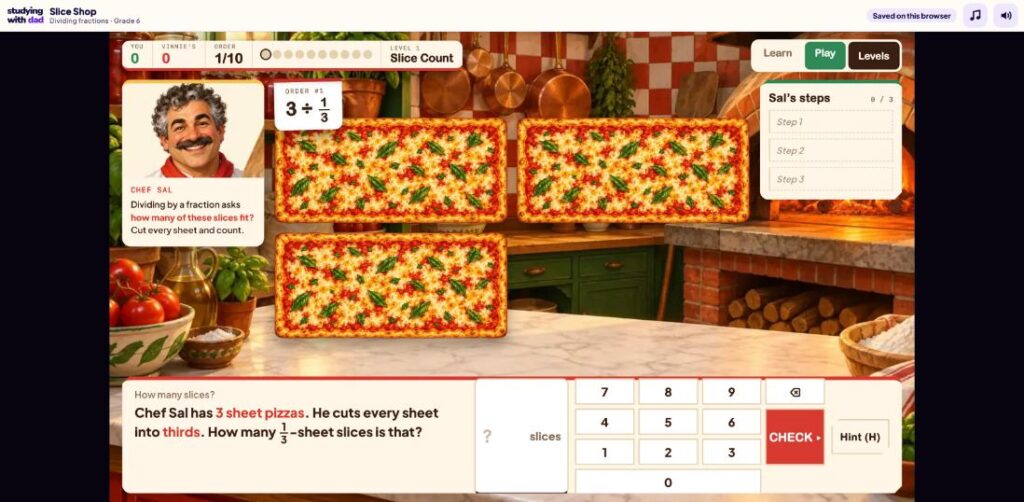
The 6th grade game Slice Shop starts with this same kind of question. Chef Sal cuts sheet pizzas into equal slices, and kids count how many slices of one size there are before the keep, change, flip shortcut appears.
Now ask how much each person gets if half a cup is shared equally by three people. Each share is one sixth of a cup, so 1/2 ÷ 3 = 1/6. These two division stories ask different questions.
Later, broader fraction division can be connected to multiplication and reciprocals. Avoid starting with “flip and multiply” if the child cannot identify what is being divided or what the quotient represents. Follow the class sequence and use the limited example that matches the current goal.
Use a misconception to choose the next rung
If a child thinks 1/8 is greater than 1/4 because eight is greater than four, revisit equal wholes and unit fractions. If they compare accurately but add denominators, revisit compatible units in addition. If addition works but multiplication is confusing, explore a part-of-a-part model rather than reteaching every earlier step.
The ladder is useful because it narrows the next action. It should not become a label attached to a child or a claim that every learner must complete identical tasks at identical ages.
Try this five-minute activity
Fold two equal paper strips into halves and fourths. Compare 1/2 with 2/4, then build 3/4 in two different ways. Ask your child to name the whole each time. Save a different example for later; coming back to the idea on another day is a simple form of spaced practice.
Dinner-table question: “How could two fractions with different names show the same amount?”
Common questions
Should we teach every operation at once?
No. Work on the stage your child needs and use later examples only to show where the idea is going.
Is a picture a crutch?
A useful representation explains the quantity and supports checking. The goal is connecting models and symbols, not rushing away from models.
Practice the appropriate rung
Each rung has a game that works on it. Fraction Pizza Shop covers equal shares, unit fractions and the number line for 3rd grade. Slice It: Pizza Counter is the 4th grade step: kids cut pies into equal slices to build equivalent fractions and add slices with the same denominator. For adding with unlike denominators, Fuel Run fills a rocket tank to an exact amount, and Full Steam and Yard by Yard: Drive put addition and subtraction on a number line. Fraction Feast shades brownie pans one way and then the other to multiply, and Slice Shop takes on division. A game should match the skill, not simply contain the word “fraction,” so pick the rung your child is on, and afterward ask for a drawing of one answer.
Keep exploring
-

How Long Should Kids Study? Start With a Focused 10 Minutes
How long should kids study? Start with a small, focused session that fits the task and your child. Ten minutes can be a useful starting point for extra practice, but it is not a rule for every age or...
-

How to Help With Homework Without Doing It for Your Child
To help with homework without doing it for your child, ask them to explain the task, find the last step they understand, and try one manageable next move. Offer a hint or a separate example before giving...