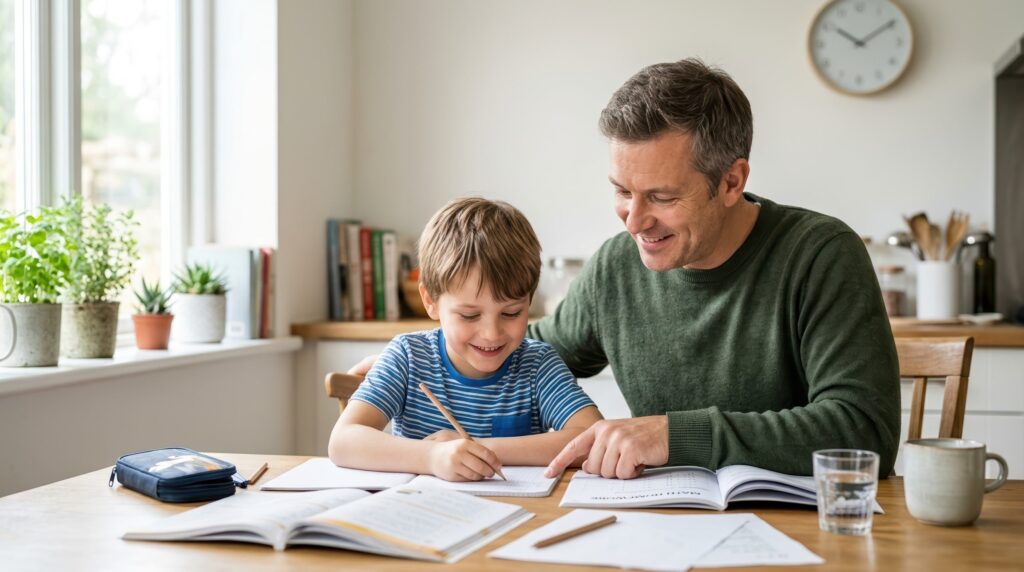
How long should kids study? Start with a small, focused session that fits the task and your child. Ten minutes can be a useful starting point for extra practice, but it is not a rule for every age or assignment. A teenager preparing an essay may need a longer work block. A tired younger child may need less.
The useful question is what your child will do during that time. Looking at a page for an hour and explaining three ideas from memory are different activities.
Choose a finish line before choosing a timer
Replace “Go study” with something observable: explain one example, recall five capitals, or solve two fraction problems and check them. The finish line helps you notice when the session has served its purpose.
Use a timer as a gentle boundary, not a threat. When it ends, decide together whether to stop, take a break, or finish the current thought. School-assigned work still needs a realistic plan; ten minutes is not a promise that every assignment will fit.
Worked example: a 10-minute session
Imagine your child is adding fractions with different denominators:
- Minutes 1–2: Review why thirds and sixths are different-sized pieces.
- Minutes 3–5: Work through 1/3 + 1/6. Rewrite 1/3 as 2/6, then add to get 3/6, or 1/2.
- Minutes 6–8: Try 1/4 + 1/2 without copying the example. The answer is 3/4.
- Minutes 9–10: Ask, “Why did the denominators need to match?” Write one next step.
If the example is unfamiliar, spend the session learning it together instead of racing through more questions.
For a 5th grader on this topic, one round of Fuel Run fits the same window. Kids fill a rocket tank to an exact goal with fuel cells such as 1/2, 1/4 and 1/8, and the gauge is marked in equal pieces so they can see a half turn into eighths. The game has no clock, so your finish line decides when the session ends.

Adjust the routine to the learner
For younger children, start with one concrete game or a handful of objects. In Count and Tap Farm, for example, a kindergartner taps each animal once while counting along with Hattie the hen, which keeps one number matched to one object. For older children, let them choose which skill needs attention. For teens, agree on a task and an independent work block, then check in at the agreed time.

Look for signs that the plan needs adjusting: repeated rereading without understanding, escalating frustration, or being unable to explain the first step. A break or a simpler example may be more useful than additional minutes.
The IES study-practice guide supports spacing learning over time and using questions to revisit content. It does not establish one ideal session length for every child.
Turn a long assignment into manageable work
A short practice session is not the same thing as the total time required for homework. If a project needs research, drafting, and revision, break it into meaningful parts rather than pretending it should fit into ten minutes.
For example, tonight's finish line might be choosing two relevant sources and writing the question the project will answer. Tomorrow's task could be a first paragraph. Build a plan around the actual deadline and leave room for questions.
Ask the child to estimate the task, then compare the estimate with what happened. If finding materials consumed most of the session, organize that part before the next work block. The lesson is planning, not blame.

Know what a useful stopping point looks like
A useful stopping point might be one explanation the child can now give, one corrected misconception, or one clearly named question for the teacher. It does not always mean a page is full or a game is finished.
Before stopping, make a brief note in ordinary language: “Can compare tenths; still checking hundredths.” Next time, the family has a place to begin without replaying the whole discussion. Keep these observations private and avoid turning them into a public sibling comparison.
If the child is engaged and wants to continue, decide whether another short task fits the evening. Do not stop mechanically just because ten minutes passed, and do not let enthusiasm become a reason to ignore sleep, meals, or other needs.

A simple way to review the routine
After a week or two, ask whether the routine made it easier to start, whether the chosen tasks were clear, and whether the family knew what to revisit. Those questions assess the routine's usefulness. They are not a controlled experiment proving that one session length caused a better grade.
Change one thing at a time: an earlier start, fewer materials to gather, a clearer example, or a smaller goal. If the work remains consistently inaccessible, coordinate with the teacher rather than lengthening every session by default.
Try this five-minute activity
Choose three questions from current schoolwork. Let your child answer one, check it, and explain a correction. Keep the remaining two for another day. Note the specific step that needed help rather than a percentage score.
Dinner-table question: “What is one thing you could explain now that felt confusing earlier?”
Common questions
Is ten minutes enough?
It can be enough for a small practice goal. It may not be enough for a substantial reading assignment, project, or exam preparation. Plan around the work and individual needs.
Should we practice every day?
A repeatable routine helps, but missing a day does not need a penalty. Resume with a small next step rather than doubling tomorrow's work.
Where Studying with Dad fits
Our games give families a defined place to practice one skill in a short session. Choose the game that matches the current topic from the game library, such as Fuel Run for adding fractions in 5th grade or Count and Tap Farm for counting in kindergarten, then ask your child to explain one decision afterward. The games are free to play on a family account that saves progress, so the next session can start where this one stopped. A completed game is practice evidence, not proof that the skill is mastered.
Keep exploring
-

How to Help With Homework Without Doing It for Your Child
To help with homework without doing it for your child, ask them to explain the task, find the last step they understand, and try one manageable next move. Offer a hint or a separate example before giving...
-

Active Recall and Spaced Practice: How to Use Them at Home
Active recall means trying to retrieve information before checking it. Spaced practice means revisiting learning across separate occasions rather than placing all attempts in one sitting. They can work...