
The short answer: the dime is the small, thin coin with ridges around its edge, and it’s worth 10 cents. The nickel is bigger, thicker and smooth, and it’s worth 5 cents. Kids mix them up for a very good reason: the smaller coin is worth more.
Here’s how to explain the difference, a few tricks that stick, and the games we use to practice it.
Dime vs. nickel at a glance
| Dime | Nickel | |
|---|---|---|
| Worth | 10 cents | 5 cents |
| Size across | 17.91 mm (the smallest U.S. coin) | 21.21 mm |
| Thickness | 1.35 mm | 1.95 mm |
| Weight | 2.268 g | 5 g |
| Edge | Ridged (118 little ridges) | Smooth |
| Front | Franklin D. Roosevelt | Thomas Jefferson |
| Back | A torch with olive and oak branches; says ONE DIME | Monticello, Jefferson’s home; says FIVE CENTS |
Hold the two side by side and the size difference jumps out. A dime is even smaller than a penny, which is 19.05 mm across.
Why is the smaller coin worth more?
It comes down to what the coins used to be made of. Dimes were once 90% silver, and silver is valuable, so a dime only needed to be small to hold about 10 cents’ worth of metal. The nickel, first made in 1866, used cheaper copper and nickel, so it had to be bigger.
Dimes haven’t been silver since 1965, but they kept their size. That’s a nice story to tell a kid, because it gives the “backwards” sizes a reason. Something small can still be worth a lot.
Five ways to tell them apart
- Feel the edge. Run a thumbnail around it. Ridges mean dime; smooth means nickel. This works even with eyes closed, or with a hand in a pocket.
- Find the smallest silver coin. In a pile of change, the tiniest silver-colored coin is always the dime.
- Read the back. The nickel says FIVE CENTS. The dime says ONE DIME and never shows a 10, which trips kids up. Point it out once and they’ll remember it.
- Check the face. Roosevelt is on the dime, Jefferson on the nickel. Jefferson’s house, Monticello, is on the nickel’s back too.
- Say it out loud: “Small but mighty.” A short phrase like this gives kids something to reach for when the sizes feel wrong.
Quick practice at home
- Coin sort. Dump a handful of change on the table and sort it into cups by coin. Then say each coin’s name and value as it goes in.
- Mystery sock. Put one dime and one nickel in a sock. Your kid reaches in and pulls out the dime by feel alone.
- Trade up. Two nickels make a dime. Let your kid trade two nickels for one dime and ask which pile is worth more. Same money, fewer coins.
- Which is more? Put 3 nickels next to 2 dimes. Most kids pick the 3 nickels because there are more coins. Counting it out (15 cents vs. 20 cents) settles it.
Games that practice it
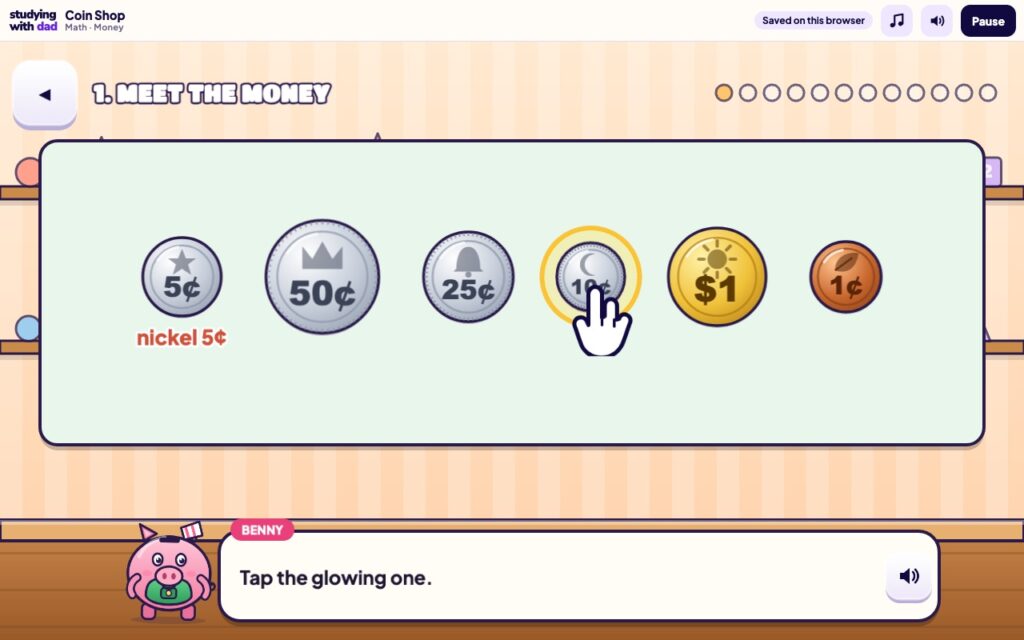
Coin Shop is our main money game, set in a toy shop run by Benny the pig. Its first level, Meet the Money, shows every coin at its real relative size, so the dime really is the smallest one on the shelf. Kids tap each coin to hear its name, and Benny tells them to watch the dime because it is small but mighty.

Then the questions start: tap the penny, tap the dime, which coin is worth more? A wrong tap labels the coin the kid picked, and the right one glows, so a mix-up turns into a lesson on the spot. Later levels count mixed coins, show two ways to pay, trade up to the fewest coins, and come back to the dime-and-nickel mix-up with Which Is More?, where 3 nickels go up against 2 dimes.
Pocket Change is a quick 10-question quiz on counting coins, made for 2nd grade and read aloud. Choose “Pennies, nickels, dimes” to keep it to the three coins that get mixed up most. Its tip is the same one: start with the coin worth the most, and remember the dime is the smallest coin but worth more than a nickel.
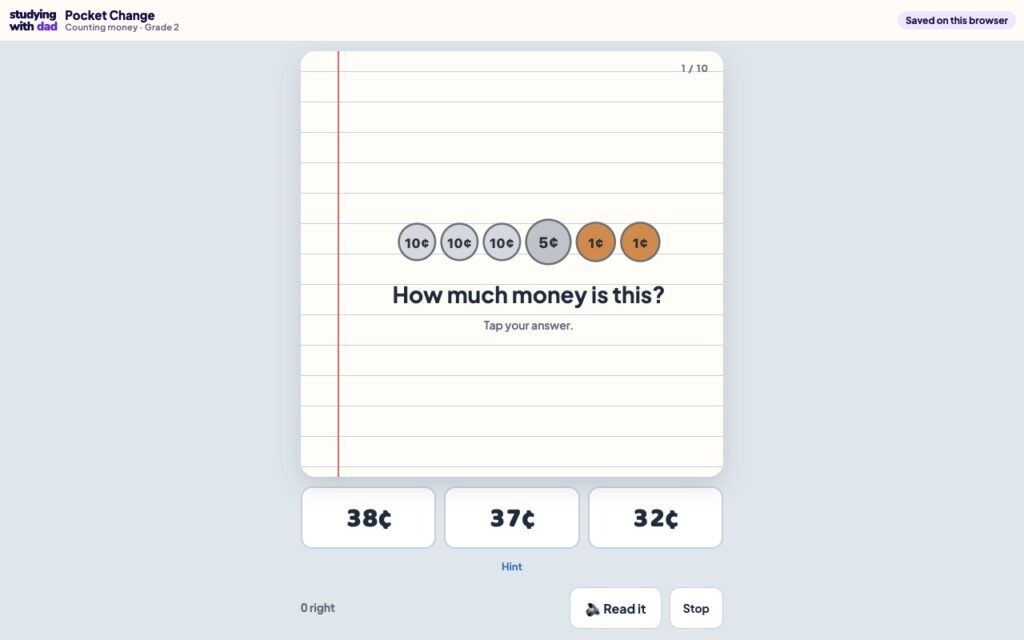
Start with Coin Shop’s first level until your kid can pick out the dime every time, then use Pocket Change to practice counting them.
Sources
- Dime (United States coin): size, weight, edge, design and silver history
- Nickel (United States coin): size, weight, edge, design and 1866 introduction