Order of Operations You Can See: A Free 6th Grade Game for Exponents and Expressions
By Instructor Dad ·
Ask a 6th grader what 5 + 2 × 3 equals, and there’s a good chance you’ll hear 21. Read left to right, it makes perfect sense. It’s also wrong (the answer is 11), and that small slip is a big deal. Sixth grade is the year math starts to look like algebra: letters stand in for numbers, small numbers float up as exponents, and the order you do things in suddenly decides whether an answer is right.
If your child is wobbly here, they’re in good company. On the latest Nation’s Report Card, only a little over a quarter of 8th graders scored at the Proficient level in math, and nearly 40% scored below Basic. The students who were already behind have been falling furthest (National Assessment Governing Board, 2025). Much of what makes 7th and 8th grade math hard starts with the expressions kids meet in 6th.
Why expressions trip kids up
Kids spend years reading everything left to right, so their eyes naturally grab the first operation they see. Researchers who watched 837 U.S. middle schoolers solve problems in an online math game found that students were more than three times as likely to make an order-of-operations mistake when the first operation on the left wasn’t the one to do first, as in 8 + 4 × 4 (Bye et al., Journal of Numerical Cognition, 2024). The same study found that kids who could quickly see when two expressions meant the same thing made fewer of those mistakes.
Exponents bring their own surprises. A common one is reading 4³ as 4 × 3 instead of 4 × 4 × 4. And “equivalent expressions” can feel like a magic trick: why should 4(x + 3) and 4x + 12 be the same thing for every x? Without a way to see it, kids memorize rules they don’t trust, and those rules fall apart the first time a problem looks a little different. A memory trick can be a useful cue, but it can’t replace knowing why the rule works.
How Mix Board helps
Mix Board turns every expression into a music mixing board. The input fader holds the value. Each channel strip is one step in the order of operations: powers first, then multiplying, then adding or subtracting. Kids run the channels in order and read the meter, so the order of operations stops being a rule to memorize and becomes something they can watch happen.
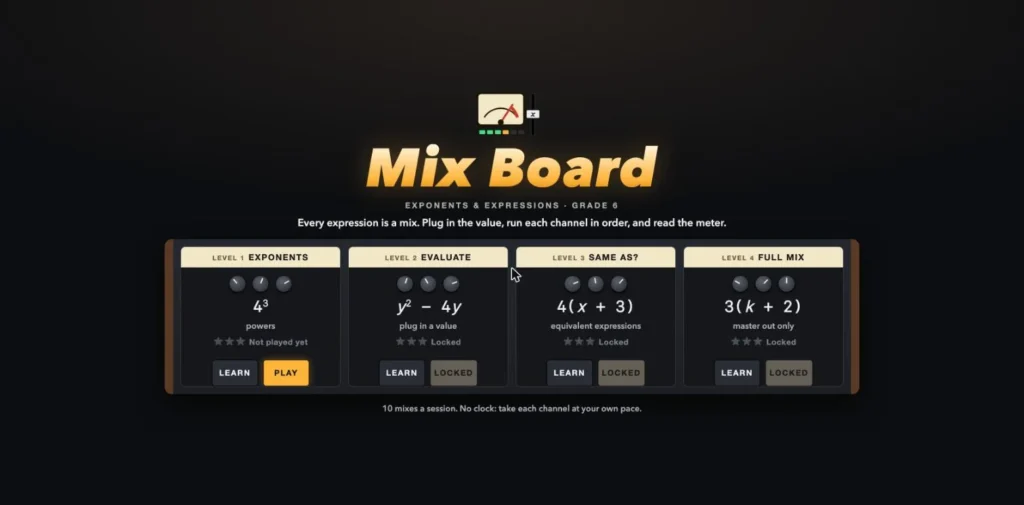
The game has four levels. Exponents builds the meaning of a power as repeated multiplication (“use 11 as a factor 2 times”). Evaluate has kids plug a value into an expression like y² − 4y and work it step by step. Same as? is the clever one: kids patch in a second expression, then sweep x up and down to see whether the two needles stay locked together. If they do, the expressions are equivalent. Full Mix takes away the channel-by-channel help and asks for the final answer only.
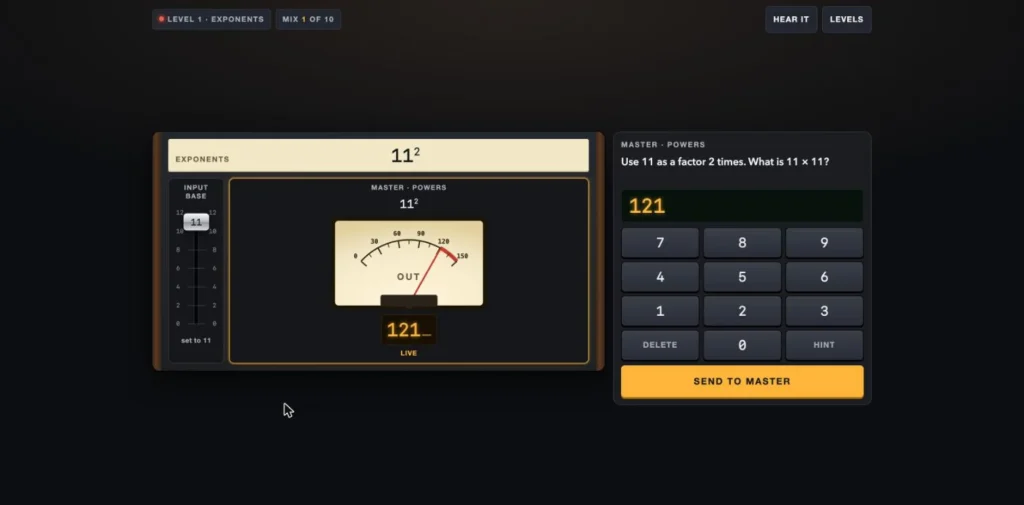
Mistakes are handled gently. A wrong value makes the channel clip red and shows a short tip. A second miss shows the worked step and moves on, and missed problems come back later in the round, a small dose of the active recall and spaced practice that helps skills last. There’s no clock, either: each session is 10 problems at your child’s own pace.
For homeschool families
Homeschooling has grown fast since the pandemic, and about 6% of U.S. students now learn at home, roughly double the rate before 2020 (Reason, 2025). If you’re one of those families, Mix Board fits easily into a 6th grade or pre-algebra plan:
- Use it as a warm-up. One 10-problem session takes about 15 minutes, a natural start to a math lesson and close to the short, focused session that works for most extra practice.
- Teach, then play. Each level has a Learn button that walks through the idea before kids practice it.
- Pair it with any curriculum. Order of operations, exponents and equivalent expressions show up in every 6th grade math program, so Mix Board works as a supplement no matter which one you use.
- Keep records. Stars for each level show what your child has mastered, which makes a simple note for your portfolio or a quarterly report.
Where Mix Board fits in your curriculum
If you follow a set program, here’s roughly where Mix Board lines up:
- Saxon Math Course 1: alongside the order of operations lessons early in the book (Lesson 5) and the exponents lesson (Lesson 73) (Pengi lesson guide).
- Singapore Dimensions Math 6A and 6B: the Order of Operations chapter in 6A, which covers exponents, and the Algebraic Expressions chapter in 6B (Dimensions Math 6–8 scope and sequence).
- Math-U-See Pre-Algebra: the exponents and order of operations lessons (Demme Learning).
- Illustrative Mathematics Grade 6 (free): Unit 6, Expressions and Equations, especially the lessons on expressions with exponents (IM Grade 6 Unit 6).
- Common Core and most state standards: 6.EE.A, writing, reading and evaluating expressions, including whole-number exponents (Illustrative Mathematics).
Lesson numbers can shift between editions, so check your book’s table of contents.
More games to try
If your child likes Mix Board, these free games build the same skills from different angles:
- Chalk Talk: more practice with expressions and exponents, including writing expressions from words.
- The Vault: solving equations and inequalities, the next step after evaluating expressions.
- Balance Beam: equations shown as a balance that has to stay level.
- Trail Tracker: two quantities that change together, where expressions become rules on a graph.
Questions parents ask
What should a 6th grader know about exponents? What a whole-number exponent means (4³ = 4 × 4 × 4), how to evaluate powers, and how to use them inside longer expressions with the order of operations.
Why does my child keep getting order of operations wrong? Most kids read math left to right like a sentence. Research shows they’re far more likely to slip when the first operation on the left isn’t the one to do first. Seeing each step as its own stage, like Mix Board’s channel strips, helps.
What are equivalent expressions? Two expressions that give the same value for every number you plug in, like 4(x + 3) and 4x + 12. In Mix Board, kids test this by sweeping x and watching whether two needles stay locked.
Is Mix Board free? Yes. Mix Board and every game on Studying with Dad are free, with no ads. Kids play with a free account, which saves their progress.
Sources
- National Assessment Governing Board, 2024 NAEP results press release, Jan. 29, 2025.
- Jeffrey Kramer Bye et al., “Perceiving Precedence: Order of Operations Errors Are Predicted by Perception of Equivalent Expressions”, Journal of Numerical Cognition, 2024.
- J.D. Tuccille, “Homeschooling hits record numbers”, Reason, Nov. 19, 2025.
- Dimensions Math 6–8 Scope and Sequence, Singapore Math Inc.
- Math-U-See Pre-Algebra concepts, Demme Learning.
- Saxon Math Course 1, Lesson 73: Exponents, Pengi lesson guide.
- IM Grade 6 Math, Unit 6: Expressions and Equations, GeoGebra.
- Grade 6 Expressions and Equations standards, Illustrative Mathematics.
- Mix Board game page, Studying with Dad.